Wednesday, 16 November 2016

Reading: Ideas for the Animated Short - Chapter 2

Chapter 2: Building Better Content
This chapter builds on the first chapter but focused more on what works for short stories specifically. It categorises short stories made by one person as being around 1-2 minutes, however I thought that my own story would be around 5-7 minutes long.

The rules of the playground
1. Story is king

2. Keep it simple
  • simple single situations
  • one conflict that intensifies
  • a single memorable moment
  • slices of life
  • demonstrations of personality
What doesn't work:
  • hero's journey
  • epic tales
  • uncharted territories/complicated concepts
  • little known facts
This section made me question whether my story would be too complicated for a short story. However since my story will be a little longer than what Schumer and Sullivan conceptualised it might be okay. Still, I will try to simplify my story as much as possible.

3. Know your concept, theme, or meaning

4. Avoid cliches

5. Create a memorable character

6. Emotion drives action

7. Show, don't tell
Many short stories tend to use little or no dialogue. Therefore its integral to make actions obvious to the audience, so that the story is still communicated coherently.

8. Create conflict (only 3 types):

  • Character vs character
  • Character vs environment
  • Character vs self
The conflict in my story will surround the idea of character vs environment.

9. Know your ending

10. Entertain audience

11. Use humour
I had imagined my story to be more of a dramatic piece, therefore I'm not sure if using humour will be relevant.

12. Do something you like
I have had a lot of doubts with my story, but I am still enthusiastic about my concept, therefore I'm determined to make it work.

Reading: Ideas For The Animated Short - Chapter 1

I've been struggling a bit with developing my project idea. Therefore I decided to do some further reading into getting ideas to get some inspiration. I found the pdf version of the book Ideas For The Animated Short: Finding and Building Ideas by Gary Schumer and Karen Sullivan. The first chapter was Story Background and Theory.

Important elements of story:
  • Character
  • Goal 
  • Conflict (between character and goal)
Other elements to consider
  • Location
  • Inciting moment (something unexpected happens)
  • Story question
  • Theme - deeper message e.g. love conquers all
  • Need - character needs to learn something to achieve goals
  • Arc
  • Ending/resolution
Examples of conflict
  • brains vs brawn
  • rags to riches
  • good vs evil
  • role reversal
  • courage and survival
Films often have primary, secondary and tertiary conflict

Themes
Three main categories:
  1. Physical needs
  2. Mental needs
  3. Spiritual needs
Within this: food; shelter; security; acceptance; stimulus; love and order
Think about how character may react to situations different than we would ourselves

Short films:
  • Dont overcomplicate
  • One theme/concept and one conflict (that intensifies/gets worse)
  • One or two characters
  • One or two locations
Response:

As I was reading the chapter I created brainstorms to try and develop my own ideas in line with Schumer and Sullivan's guidelines.

The means of conflict that stood out the most to me were "quest", "rags to riches" and "courage and survival". I think that "quest" would work as the "primary conflict", since the main character will go on a quest to find her family. Instead of using the "rags to riches" narrative, this would more likely be subverted in my own narrative, as the city of Paris went from being an economic success to a crumbled society. There will almost be elements of "courage and survival" within my story, as the main character will overcome the "environmental struggle" of the post-apocalypse.

Tuesday, 15 November 2016

Viewing Log: Akira (1988)


Director: Katsuhiro Otomo
Distributor: Toho

In 1988 the Japanese government drops an atomic bomb on Tokyo after ESP experiments on children go awry. In 2019, 31 years after nuking the city, Kaneda, a bike gang leader, tries to save his friend Tetsuo from a secret government project. He battles against anti-government activists, greedy politicians, irresponsible scientists and a powerful military leader until Tetsuo's supernatural power suddenly manifest. A final battle is fought in Tokyo Olympiad exposing the experiment's secrets.

Story
  • Based on Manga comic series
  • Considered to be the best animated sci fi film. This relates to my own work as I will be making an animation film in the sci-fi dystopia genre. 
  • Civillians are surveilled by the government
  • The general public proceed with their everyday lives despite the war thats occuring 
Mise-en-scene


  • Overall the film was extremely visually pleasing to watch due to its elaborate set design
  • Realistic use of lighting and shadows
  • Setting - school trashed: graffiti and rubbish everywhere. This correlates with the dystopia genre and emphasises the war torn setting
  • During Testuo's dream: lighter, washed out colours; soft blur - connotes a happy memory
Camera


  • Many aerial shots of the city
  • Parallax camera effect
  •  Canted angles to emphasise chaos
Editing

  • When Tetsuo has flashbacks a series of images are quickly presented (lasting about a frame each)
  • I would like to use a similar effect in my own work

Sound
  • Often sounds are echoed to connote an abandoned setting
  • Themes of chaos are highlighted through the use of diegetic sounds such as gunshots and explosions
Overall thoughts:
I did find the film to be extremely confusing, especially as the story progressed and more supernatural elements are added. Yet I can understand why it is culturally relevant, and there are still many ways that I'm inspired by it.

Workshop 9

Funding
  • Most funding not open to students
  • Crowdfunding
    - compassion based
    - focused and engaged audience
    - friends and family
    - other students 
  • Think about who is likely to want to see the project completed
  • Be mindful of fees and think about reception
  • Which country? (if international)
  • Don't promise too much in return
  • Host events
    - pub quiz
    - club night
    - raffles
    - cake sale
  • Be clear about regulations
Post-grad funding
  • Local council funding (borough; neighbourhood)
    - quick turn around
    - set deadlines
    - not a lot of money (few hundred)
    - can ask for advice
    - don't appear naive
  • Arts council (Gfta)
    - nation lottery
    - small big grants
    - takes about 3 months
    - can see everything been funded
    - can ask for feedback
    - not for film
    - lottery arts for all > community skills and benefit
  • In-kind donations
    - something of value given for free
  • Private donations
  • Large project grants (3 years)
  • Focused funding schemes
  • Fabrica gallery mailing list
Tips for application:
  • Make them believe in your project
  • Explain project idea and why it matters
  • How it relates to other existing media

Monday, 14 November 2016

Aesthetic Experimentation 3


Since I am going to set my animation in Paris, I looked at images that I could use as inspiration. I know that the city has beautiful architecture, however this could be quite difficult for me to draw. I used this image because I like the lighting.


I began by tracing around the image using lots of straight lines. I tried my best to simplify it, using the advice I took from 'The Art of Princess and the Frog' (see post: Reading: The Art of Princess and the Frog).


Here is the final result of drawing out the image. It wasn't as difficult as I thought it would be, however it was quite time consuming.


The next step was the colour the image. I tried using the eyedropper tool to select colours from the original image. However I didn't like the way it was turning out. I decided not to continue colouring the image, as I thought it might be better to try again with creating my own colour palette on another picture.


Wednesday, 9 November 2016

Viewing Log: 28 Days Later

Director: Danny Boyle
Distributor: Fox Searchlight Pictures

A group of misguided animal rights activists free a caged chimp infected with the "Rage" virus from a medical research lab. When London bike courier Jim (Cillian Murphy) wakes up from a coma a month after, he finds his city all but deserted. On the run from the zombie-like victims of the Rage, Jim stumbles upon a group of survivors, including Selena (Naomie Harris) and cab driver Frank (Brendan Gleeson), and joins them on a perilous journey to what he hopes will be safety.

Story
  • The film follows the trope of the post-apocalypse genre by featuring an isolated (male) character. He is initially shown scourraging for food.
  • He continues to wander through the streets of London; conveniently on Westminster Bridge, thus setting the scene for the audience. 
  • After some time passes he finds other humans, Mark and Selena, who explain the situation
  • Jim is in disbelief when he's told that most people are dead
  • Selena is represented as being a heroine, arguably much stronger than her male counterpart. She is seen brutally defending herself against someone infected with the virus. She does whatever it takes to survive.
  • The storyline gives the audience hope as they move to a new city in the aims of starting over 
  • The most climatic scene occurs when Jim kills all the soldiers. The film gets quite graphic including an intense eye gauging scene. 
  • At least it has a seemingly happy ending - a helicopter comes to save them, foreshadowing a new life of happiness
Mise-en-scene


  • The colour grading in the film tends to favour red, especially in shots where there is a lot of blood
  • Tends to heavily use shadows, wavering between lightness and darkness. When shown at the beginning of the film it creates a sense of mystery as the characters appear to be living in secret.
Camera
  • obscure angle, close up
  • long take, slow pan and emotional story explaining disaster
  • lots of canted angle shots
Editing
  • begins with news footage and zooms out to reality - glitchy aesthetic - sound and visual editing 
  • editing fast paced
Sound
  • In the beginning of the film it is almost silent
  • Later on in the film elements of horror are introduced with sudden noise and action
  • When the characters drive out countryside peaceful non-diegetic music is heard, suggesting that the equilibrium is restored
Overall, I can already notice a lot of similar tropes in the post-apocalypse genre that are present in both 28 Days Later and I Am Legend. For instance the use of an isolated character who finds allies, yet somehow manages to fight off zombies all by himself. The sound tends to be very minimal except for in moments that are intended to shock the audience.

Tuesday, 8 November 2016

Tutorial


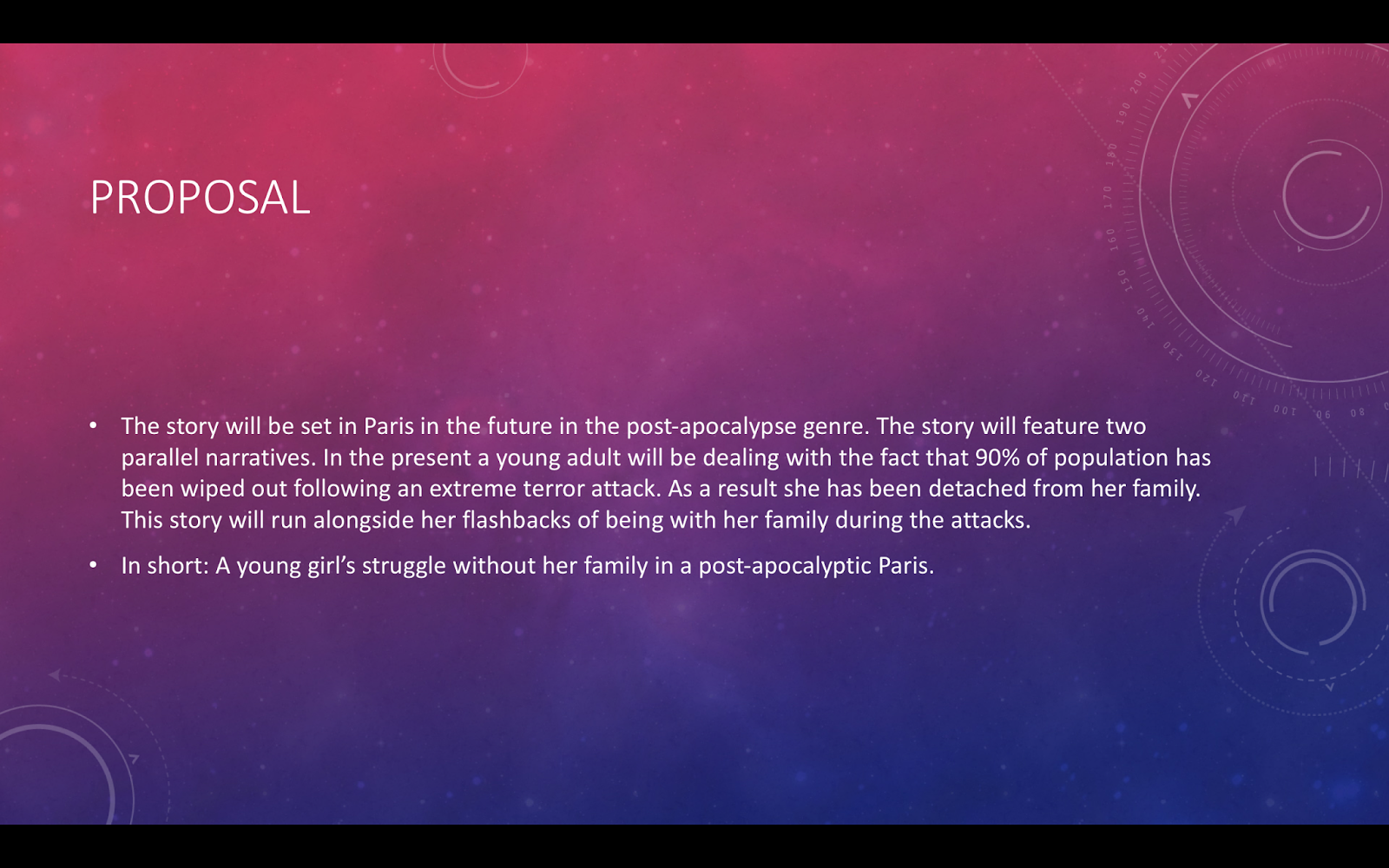
I put together another, more thorough presentation with my new ideas to show to Mary.


I still haven't fully mapped out the whole of my narrative, however the main plot will be about a girl who is living in a post-apocalypse Paris. During the story she has flashbacks to the event in which she lost her family. 


I was originally inspired by a technical experimentation I did of a setting in Paris (see post: Aesthetic experimentation 2). In general I think Paris is a visually pleasing location due to its architecture and has so much interesting culture and history. It has also been the backdrop for many animated movies such as Ratatouille (2007), The Hunchback of Notre Dame (1996) and Rugrats in Paris (2000).


I did some research into the state of Paris at the moment, following the various terror attacks that have happened. Especially since the terror attacks in 2015, Paris has a high increase in security.

A friend of mine who is doing a year abroad in Paris said that the security is now much higher than when we visited last year. This in effect makes you feel quite uncomfortable and fearful, in a way that reduces the charm that Paris usually has.

I also read an article about how "the streets are emptier than usual" creating an eerie atmosphere "like you're in an episode of The Walking Dead".

"The now permanent presence of thousands of soldiers in khaki across the capital and major cities has transformed the image and mood of France." 

It seems as though Paris is already in a semi-militant state and for my project I would consider portraying a hyperbolic representation of this.

References:
https://www.theguardian.com/world/2016/apr/15/paris-attacks-operation-sentinelle-soldiers-patrolling-streets-france-safer
http://www.pri.org/stories/2016-08-22/year-attacks-leave-paris-streets-emptier-usual


I conducted further research into the genre as I wasn't sure whether my idea counted as post-apocalypse or dystopia. It is possible for the genres to be used together, for example in The Hunger Games. However the genres do have distinct features. At present I believe my narrative will lean more towards post-apocalypse, as it will be to do with survival in a barren city, whereas dystopias tend to focus on corruption and fighting against the state.


At the moment I have come up with two main characters for my story. The first will be a female in her early twenties and the second character will be her younger sister. I will develop their characters more once I have considered the outline of my narrative.


In terms of sound, I would like to use little dialogue. This seems to be a trope used in many short film animations such as Somewhere Down the Line where there are only a few lines of dialogue, or The Sandman where there is no dialogue at all. The downside to using minimal dialogue is that it will require a more effective use of soundscape and score, which I am not talented at creating myself. I may need to enlist some help in creating sound for my project. I do still think it will be exciting to look into sound design in films such as Fantasia since they also don't use much dialogue.


Finally I outlined the questions I asked myself about the project about the doubts I had. I asked Mary her opinion to see how well my ideas would work. In terms of using the post-apocalypse genre, I thought it might be too big and too complex for a short film. However there are short films that already exist in the genre such as 9 (2005). Mary said that it is fine to use this genre as long as I'm specific and think about the structure clearly. I'm also quite happy to explore the genre as I think it would give me more creative freedom than doing something factual based.

I worried that basing my idea on the 2015 Paris attacks might be too current and too sensitive for audiences, however Mary argued that this is fine.

I thought that the narrative structure I'd like to use may be confusing for the audience or hard to explain. Yet, it has been done before, for example in the film Love (2015); even I Am Legend (2007) includes flashbacks. Mary reassured my that any narrative structure is okay to use as long as it is planned out carefully.

Further feedback
Suggested viewing:
  • 28 Days Later
  • Le Jete
  • Children of Men
  • Blade
Look into:
  • Apocalypse narratives
  • Religion
  • Redemption
  • Zombies and superheros
  • Vampires and race
Experiment with:
  •  Backgrounds and texture